
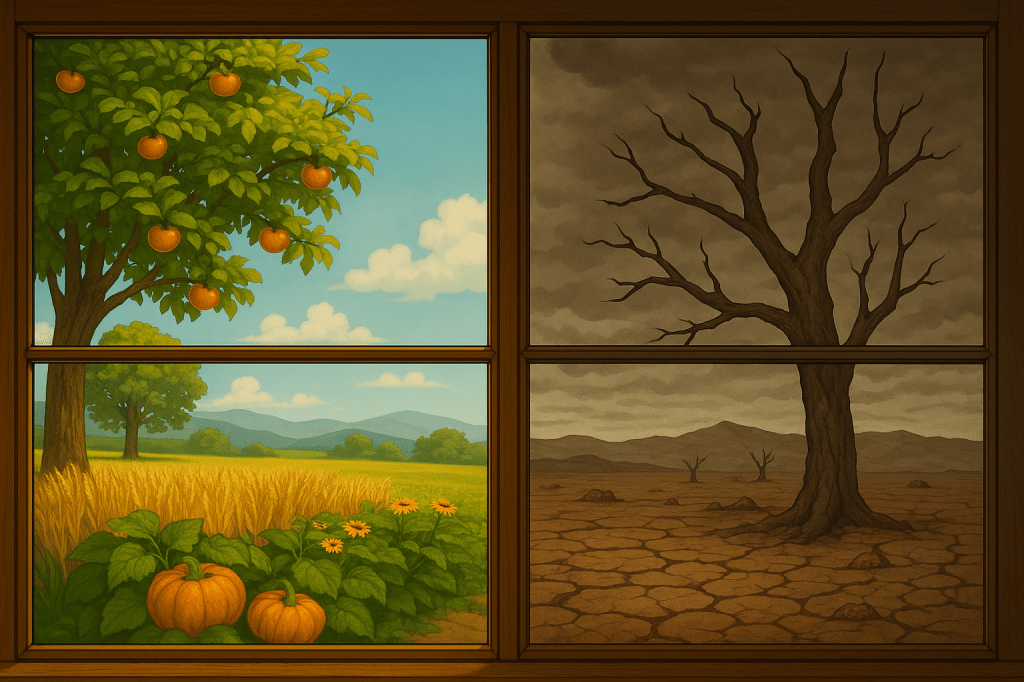
Have you ever wondered why two people looking at the same event can feel completely different things? Or why some people constantly live in “lack”, while others experience “abundance”, no matter the circumstances? The answer may lie in the window through which we view the world.
Let me continue with a quote from Haemin Sunim’s book The Things You Can See Only When You Slow Down:
“There is a famous Buddhist saying that everyone appears as buddhas in the eyes of the Buddha and everyone appears as pigs in the eyes of a pig. It suggests that the world is experienced according to the state of one’s mind.
When your mind is joyful and compassionate, the world is, too. When your mind is filled with negative thoughts, the world appears negative, too.”
In essence, everyone shapes their life through their own perspective. Negative thoughts lead us to interpret events negatively and cause us to focus on the empty side of the glass in every situation we encounter.
This is not just a spiritual or philosophical matter — it also affects our financial mindset. If you look at life through a window of scarcity, you will only see lack and inadequacy. Earning a small amount of money and constantly focusing on it, comparing ourselves to what others have, will drag us into a spiral of unhappiness and into a state of mind that becomes increasingly difficult to escape. If we constantly think in terms of lack and insufficiency, what we have will never feel enough. Having a low income might be a reality; but the meaning we assign to it, determines the impact it has on us.
If we seek happiness not in money but in the events we experience, we may save ourselves from falling into this spiral. And when that happens, we will realize that we are actually richer than we thought.
A Scenario: Town and City
Let’s consider two different life scenarios in the United States.
One person lives in a small town in North Carolina. They earn $55,000 a year. Their rent is $900 per month, and they spend around $700 on basic monthly needs like groceries, transportation, and utilities. That leaves them with about $16,800 in annual savings. They work 9 to 5, and spend their free time hiking nearby trails or enjoying a quiet local lake.
Another person lives in New York City. They earn $180,000 a year. Their rent is $3,800 per month, and their other expenses come to $2,000 per month — a conservative estimate given the cost of living. That leaves about $28,800 in savings annually. However, they work long hours, often from 9 AM to 8 PM, and after commuting and managing personal responsibilities, they have very limited personal time. On top of that, they are constantly surrounded by high earners and luxury lifestyles, making even a $2,000 monthly spend feel inadequate.
On paper, the person in the city seems to earn more. But the real question is this:
Which of them is truly living in “abundance”?
The Answer Is Not Money
Of course, these assumptions are very simple. Life is a much more complex setup. But I want to make a point here: earning more does not always mean better quality of life. More time, less stress, more nature and satisfaction can sometimes be hidden in “less.”
The answer to the question often lies not in money, but in perspective. A person who sees life through the lens of abundance knows how to be content with what they have. The other, no matter how much they earn, cannot escape the feeling of lack.
Final Words
Everyone believes they will be happier once they attain what they don’t have — and this is a very natural human behavior. But the real virtue lies in being able to see the value of what we already possess. Listening to ourselves, knowing what we want, analyzing it, and observing — even from a bit of distance — can be simple steps that make it easier to appreciate what we have.
Life is a matter of perception.
Abundance begins not in a bank account, but in our minds.
And to see it, all we need to do is change the window we look through.
If you view life through the eyes of abundance, you will live in abundance.
 The Monk of Abundance