Today, most of my money goes into ETFs (exchange-traded funds). I still keep a system I trust for picking individual stocks from time to time, but the bulk of my portfolio—around 75%—is in broad index funds and ETFs. The rest is a mix of early stock picks I’ve held onto and a handful of companies that my system has flagged as promising.
The Hidden Cost of Complexity
When I first started investing, people told me I could do better than the S&P 500. That my portfolio could “outperform.” Once I dug into the numbers, I realized how misleading that idea was. Roughly 80% of active fund managers—people whose full-time job is buying and selling stocks—fail to beat the S&P 500 over time.
That means most of us, without insider knowledge or decades of experience, don’t stand a chance. Even legendary investors like Warren Buffett and Peter Lynch remind us that unless you have expertise, you’ll probably lose money trying to pick winners. And if you had that expertise, you wouldn’t be reading this—you’d be running a hedge fund.
Another issue: industry leaders are always shifting. Just look at the history of the S&P 500—companies rise, companies fall. What seems like a “forever stock” today may be forgotten tomorrow. Even buy-and-hold isn’t bulletproof if you’re clinging to yesterday’s giants. The video below visualizes that clearly.
Then there’s the literal cost of complexity: commissions, spreads, and taxes on every trade. The more you churn your portfolio, the harder it is for your returns to keep up.
Wealth doesn’t come from clever tricks. It comes from patience. Time is your ally; safety is what lets you sleep at night. Sure, you can gamble occasionally, but even then, do your homework.
And don’t fall for the social media gurus promising “5 steps to beat the market.” If their magic worked, they wouldn’t be busy posting TikToks—they’d be quietly compounding wealth.
As Steve Jobs said: “Simplicity is key.”
A Recipe That Works
One of the most popular frameworks is the 3-fund portfolio:
A total U.S. stock market index fund
A total international stock market index fund
A bond index fund
It’s boring, but it works. It’s diversified, resilient, and almost effortless to manage.
Personally, I spice it up. I hold:
QQQ (tech exposure)
SPY (the S&P 500 itself)
SCHD (for dividends and income)
VT (global exposure)
MCHI (a small bet on China)
This way, I combine growth, resilience, and income streams. Of course this is not an investment advice. You can even buy ETFs of certain sectors you think will flourish in the coming years (alternative energy, electric cars, AI, etc.)
The “Set It and Forget It” Mindset
The hardest part of investing isn’t choosing the funds—it’s managing your own behavior.
Do your budget, allocate money to investments, and keep adding regularly. Don’t try to time the market. Don’t panic when things fall. And never invest money you’ll need in the short term.
When markets drop, see it as a discount—your money buys more shares than before. Think decades, not days. Investing isn’t about getting rich fast; it’s about quietly, steadily building wealth.
Peace comes when you realize you don’t need to chase every opportunity. You need a simple system, the discipline to stick with it, and the patience to let time work its magic.
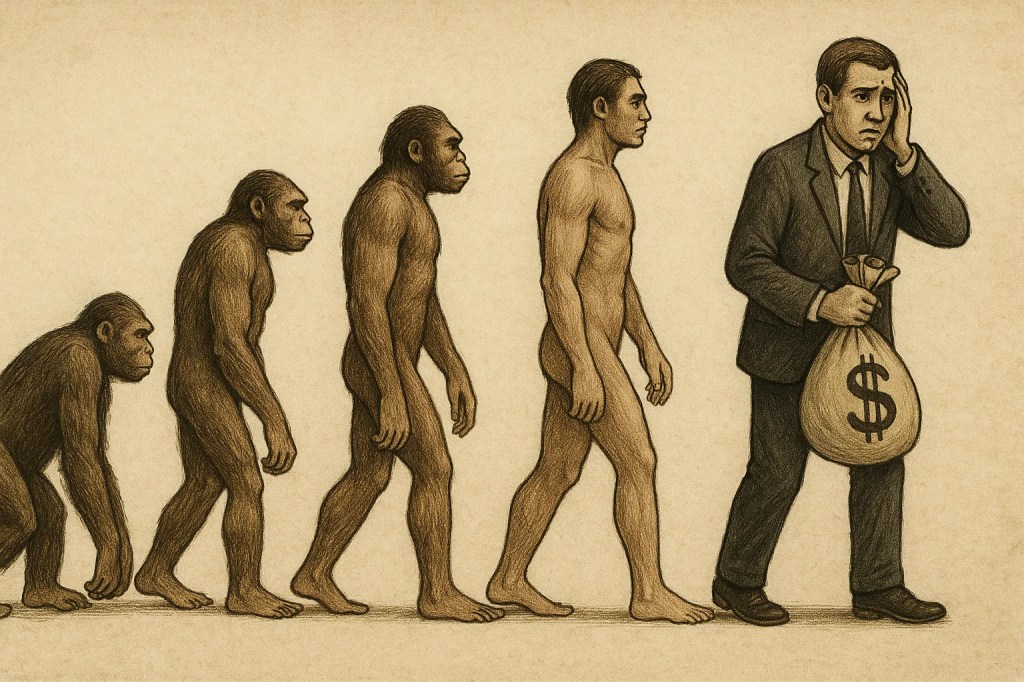
Human nature may be shaped by much older codes than we think. The roots of our anxieties might lie deep within our evolutionary history. These ancient codes may still be triggering us in today’s modern world.
In The Denial of Death, Ernest Becker argues that humans have evolved into “hyper-anxious” beings. He writes:
“Darwinians thought: early men who were most afraid were those who were most realistic about their situation in nature, and they passed on to their offspring a realism that had a high survival value. The result was the emergence of man as we know him: a hyperanxious animal who constantly invents reasons for anxiety even where there are none.”
In other words, the most cautious early humans—those who feared, hesitated, and avoided risk—were the ones who survived. That tendency was passed down through generations, bringing us to where we are now: a species capable of generating anxiety even when there’s no real cause.
Modern Threats: Money, Status, and the Future
We no longer need to run from a tiger in the forest to survive. But that internal alarm system still runs strong. And if you ask what triggers it the most today: it’s money. Or more precisely, the uncertainty, status pressure, and future worries that revolve around it.
The wealthy live in fear of losing what they have; the poor fear not being able to sustain their lives. And the middle class? Perhaps they feel the most squeezed—juggling the fear of losing what they’ve gained while trying to appear as if they belong to the next tier. A better house, a better vacation, a better car… each becomes a fresh source of anxiety. As our income increases, so does our standard of living—and instead of easing our worries, this only adds to them.
The Sense of Enough: Knowing When to Stop
Maybe the real problem starts here: the concept of a “saturation point” has all but vanished. “Enough” has become a moving target. But if we could pause for a moment, define what’s enough for us, and keep the rest as a safety net, that might significantly ease our anxieties.
If we could distance ourselves just a bit from status addiction, constant comparison, and the idea that “more is always better,” perhaps we’d find ourselves closer to peace.
Revisiting Our Relationship with Money
Then there’s the matter of how we manage money. Especially when it comes to investing, our minds are haunted by the question: “What if I lose it?” This is where risk appetite comes into play. We should be asking ourselves: What kind of investment would let me sleep peacefully at night?
Since everyone’s perception of risk is different, “safe” for one person may mean time deposits, while for another it might mean index funds or hand-picked stocks. The key is to stay within what we know and resist getting caught up in other people’s games and FOMO.
The Bottom Line: Choose What’s Right—Not What’s More
By improving our financial literacy, following a path that matches our risk profile, and—most importantly—not blindly chasing “more,” we can lead lives that are less anxious and more content. That’s how we bring peace to both our wallets and our minds.
If we can build and commit to a financial and lifestyle model that truly suits us and free ourselves from the constant chase for more, I’m confident we can reduce our anxieties to a minimum.
“All returns in life, whether in wealth, relationships, or knowledge, come from compound interest. Play long-term games!”
Naval Ravikant
Compound Interest Returns
Investments made in small sizes grow over time through the snowball effect, bringing us significant gains. Nick Maggiulli’s book Just Keep Buying is an excellent guide to understanding the snowball effect of investing. A chart in the book clearly shows how your savings and investments compound over time. In the chart below, the dark gray area represents your savings, while the light gray area represents the share of investments in your wealth. As the years progress, even if savings remain constant, the share of investments grows, and by the end of 40 years, it constitutes the majority of your wealth. (Yes, 40 years. Long-term is good. Start investing now! There’s no get-rich-quick scheme.)
Returning to Naval’s initial statement, we’ve illustrated how wealth grows through compound interest. But what about the other parts of your life? You may have saved a lot of money, and your investments might grow so much that you no longer need to work, leaving you with ample free time. But do you have the health needed to enjoy spending that money? Or the social circle to share it with? That’s exactly the question Naval is raising. He says, “All returns in life” grow through compound returns. In essence, everything accumulates in our lives.
Investing in the Future
“Play long-term games” is the less obvious part of this equation. It’s easy to understand, but people don’t want to believe it. We looked at 40 years in the chart above. This is a timeframe you’ll see almost everywhere. When it comes to investing, unless it’s a scam, timeframes typically start at 15 years. It seems those who consistently “play long-term games” in life are the ones who win. Instead of focusing on short-term quick-wins, if you think long-term and evaluate everything through this lens, you’ll become a very different person. Short-term gains—whether in money or other areas—are rarely built on solid foundations. They often rely on chance and are far more likely to be fleeting.
Non-financial areas are equally critical. Don’t neglect your friends and family for short-term gains. You might want to dedicate all your time to work today to earn more money. However, in the long term, this might lead to loneliness. Similarly, don’t forget to discover yourself and spend time on your interests due to work intensity. The true meaning of life lies in these areas. Spending time with your child, chatting with friends, making your family happy—these should be your top priorities in life. Prioritizing money over these could leave you alone when it comes time to spend it. Life grows through sharing. Those people aren’t there for your money. If anyone around you pressures you to make more money, distance yourself from them. Very few people live a materially driven life and experience true happiness.
Money and Happiness
Nick Maggiulli says in his book: “Ultimately, your money is a tool to help you live the life you want.” This is crucial to remember. Money is merely a tool to make life easier; it should never be the goal. It can help create experiences that add meaning and value to your life, but it cannot be the sole source of happiness. The material things you buy with it often provide only temporary satisfaction. True happiness lies in shared memories, unique experiences, and a life shared with loved ones.
Of course, finding what truly makes you happy is a challenging process. Often, we believe material things will bring us happiness. But in the long run, these things lose their meaning and may leave us feeling empty. That’s why focusing on “experiences” in the search for meaning in life, is a far more enduring and valuable strategy. The real wealth of life lies in these experiences and the connections that cannot be bought with money.
I want to share something I noticed years ago at a wedding I attended. It was in a luxurious hotel in Italy, and the guests were quite a high-profile group. Expensive suits, luxurious watches, and a sparkling decor—the atmosphere was like a movie scene. However, when I spoke to the people, I realized that behind this outwardly “wealthy” image, there was deep unhappiness. People with family businesses talked about their conflicts with their fathers, and almost everyone, regardless of gender, mentioned their use of antidepressants. There was plenty of money, but very little happiness. There was wealth, but no joy, no contentment. Instead, there was scarcity, the constant pursuit of more, an inability to appreciate what they had, a senseless race, and depression. This experience confirmed something for me: money does not fill life with meaning; it is merely a tool. True happiness lies beyond what we own—in shared moments and meaningful relationships.
A Long-Term Mindset
Invest in your social relationships. These are your most valuable assets in life. Long-standing friendships, where you can share joy in good times and troubles in bad times, are priceless and irreplaceable. This is a more important asset than all your wealth. Just like your wealth, your friendships will compound and grow over time when you share experiences, making the “long-term” perspective crucial here as well.
Exercise daily for your health. Keeping your body active with even a little exercise can help you maintain your fitness and increase your chances of leading a healthy life in the future. Remember, after a certain age, reaping the benefits of exercise becomes much harder. However, people who have exercised regularly for years continue to see the gains even as they age. It’s a proven fact that incorporating both resistance and cardio exercises is essential for good health.
Investing in your health long-term will yield significant returns in the future. The effects of daily exercise may not be noticeable right away, but you’ll understand them years later.
Knowledge works the same way. “It’s never too late to learn” is a very true saying. Warren Buffett often emphasizes the value he places on reading. He says he spends 80% of his day reading.
Let me admit something: after high school, where I read mandatory books, I hardly read at all—until four years ago. Considering I’m now 40, that’s a very long time. Two factors helped me start reading again. The first was discovering e-books. Reading on an iPad or Kindle was revolutionary for me. The second was gravitating toward books that aligned with my interests. Books on investing, human development, history, meditation, and mindfulness… Once I started reading these, I couldn’t get enough. I became someone who reads 20 minutes every morning and 1-2 hours on weekends. As I accumulated knowledge, I began enjoying books even more. I started taking notes, comparing arguments, and delving deeper into topics as I consumed related content. While much of this knowledge isn’t something I use daily, I feel enriched within. I’ve realized I can apply what I know in various fields and interpret situations more clearly.
By reading about others’ experiences, we can add to our own. The investment in knowledge we make today may not yield immediate returns, but it will benefit us in the future. As Benjamin Franklin said: “An investment in knowledge pays the best interest.”
Play Long-Term Games!
The one unchanging truth is that in every area of life, where you build incrementally every day, month, and year, compound returns can bring extraordinary results. Listen to Naval and play long-term games. Surrender yourself to the power of compound returns. It will take care of the rest. Incorporate the power of compounding into your life with a small step today!
Albert Einstein put it beautifully: “Compound interest is the eighth wonder of the world. He who understands it, earns it; he who doesn’t, pays it”
Recently, I read this book about financial freedom. I think it is one of the books that should be read on this path. It explains in detail how to achieve financial freedom with a simple and clear narrative.
There is also a short section on investing. The authors emphasized that this investment section is included only to establish a basic logic. In other words, this book is not sufficient to learn about investing. However, one part, in my opinion, explains very well the necessity of having a system for investing.I wanted to share my thoughts on this section.
I’m leaving the original quote below:
“The best way to avoid behavioral mistakes is to develop systems, remove yourself and your emotions, and allow the process to do the work for you. Part of the process of being a passive investor is acknowledging that the road is bumpy, and you will be subject to some luck, accepting those facts, and then proceeding anyway.
The best way to accomplish this is to focus on things you can control, particularly earning more and spending less to develop a higher savings rate.
When the market goes up, your invested money will grow. When the market dips, new money you invest will go toward buying more shares. No matter what the market is doing, you’ll be progressing toward FI.”
Some Key Points to Highlight
First and foremost, a system free from emotions and personal character is really important. This saves us from panicking when prices fall and making mistakes like getting caught up in trends and buying shares at their peak.
What Does Being Systematic Mean?
It’s possible to observe significant mistakes being made in stock market investments. People can suffer huge losses by investing in stocks they hear about from here and there, thinking that newly public companies are guaranteed sources of returns, or jumping on the bandwagon of rising stocks at the last moment with FOMO (fear of missing out). The root causes of these are ignorance and the lack of a system.
Not everyone needs to be highly financially literate. Not everyone needs to know how to analyze stocks and balance sheets. But everyone must have an investment system. Otherwise, there is no difference between investing and gambling.
It is impossible to know where a stock or the market will go—not “nearly impossible,” but completely impossible. For this reason, we cannot control this part. However, we can control how much money we allocate for investment each month. For example, instead of buying another piece of clothing, we can allocate this money for investment. Therefore, investing money into a stock fund, regardless of the market’s direction, can be a system. You don’t need to be a stockbroker to do this. Simply, being consistent will suffice. When you invest regularly every month, if the market goes up, your money grows, and if it goes down, you buy more shares with the amount you invest, and you will be happy in both cases. When shoes go on sale, we don’t hesitate to buy them, but when stock prices fall, we panic. Here, we can think of a good company as just being “on sale.”
In reality, the topic is very simple: almost everyone can manage to regularly allocate some money from their income and invest it systematically into a stock fund. In this way, it becomes possible to watch our investments grow in the long term, independent of price fluctuations.
My Personal Investment System
Now, I’d like to talk a bit about how I apply this myself. I prefer investing in the U.S. stock market rather than the Turkish market. This is a personal preference. Even though there are very good Turkish companies, I haven’t come across a stock that fits the system I describe below.
I am not a financial analyst, but I can say that I’ve read most of the essential books on investing. Based on the information I’ve gathered from these books, I’ve created an investment system.
The Core of My System
Essentially, I have two methods:
Index Funds or ETFs: I aim to keep about 50–60% of my investment size in S&P 500 ETFs. The reason is that I believe these funds are safer. This can actually be defined as believing in the long-term success of American companies or the economy. I think the potential for upward movement is higher than the potential for decline. To reiterate, I am not a financial analyst. Therefore, I don’t have enough time or expertise to select individual companies, and investing all my money in individual companies doesn’t align with my risk perception.
Individual Stocks: However, I also enjoy investing in individual companies. I follow a system for this, as mentioned earlier. Over time, I’ve built a checklist that I continuously update by adding new criteria. I evaluate the performance of each company based on this list.
The list is below with the threshold for each criteria. All of them are stuff I can gather by looking at a company’s financials.
Here are some examples from my list:
Gross Margin:
I require this to be at least 40%. This is a non-negotiable criterion because, according to general opinion, companies with this margin are believed to have stronger product/service structures and stand out from competitors.
Free Cash Flow (FCF):
This measures how much of the cash generated from operations a company can retain for discretionary use. I want this to be at least 5%. The higher this percentage, the better.
Companies that meet most of the criteria on my list are ones I consider good. While some criteria are non-negotiable, I may slightly expand others when selecting companies.
Valuation Methods
After identifying good companies, the next step is valuation. Paying a high price for a stock, even for a great company, can lead to losses. I evaluate valuation using two main methods:
Price-to-Earnings (P/E) Ratio:
The P/E ratio helps investors determine if a stock is overvalued or undervalued compared to its earnings potential and industry peers.
If the P/E ratio has been in a downward trend over the past five years, I assume the stock is undervalued. Although this is not a very strong indicator, it serves as a directional guide.
Discounted Cash Flow (DCF) Analysis: This involves predicting the future earnings of a company and calculating its present value to determine a stock price. If the current stock price is below this calculated value, the stock is undervalued.
For DCF analysis, I use a tool called Simply Wall Street, which provides free access to data for up to five companies per month. It includes DCF analysis based on analysts’ average forecasts and their one-year price predictions. I use these predictions to estimate where the stock price will be in the short and long term.
Additionally, as Warren Buffett suggests, I ensure a margin of safety. This is like insurance for mistakes on estimations. For widely analyzed stocks (like Google or Tesla), I require the price to be at least 20% below the calculated value. For lesser-known stocks, I require at least a 50% discount.
Final Thoughts
Investing in individual stocks without sufficient knowledge and confidence is highly risky. However, not investing at all is not an option. Index funds or ETFs provide a valid and effective system. You can choose ETFs or funds on different industries such as solar panels or computer chips, or you can prefer to invest in the stock market in general using S&P 500 or Nasdaq indices. Pick you method and keep investing in it regardless of market direction and you will be fine. By investing consistently in funds and not panicking during downturns, it is possible to see an unexpectedly large portfolio after 10–15 years.
Let’s not forget, stock market investment is full of ups and downs. The most important points are:
Not panicking and continuing regular investments.
Avoiding investing money you’ll need in the short term.
Not trying to invest using borrowed money.
By following these rules, our chances of success increase significantly. Investing is a long-term marathon, not a shortcut to wealth. As the time horizon extends, so does the likelihood of success.
References:
Faircloth, Chris, and Jonathan Mendonsa. Choose FI: Your Blueprint to Financial Independence. The Experiment, 2019.




 The Monk of Abundance